This is the conversation we need to have about crystals and healing—one that honors both ancient wisdom and honest inquiry, that respects what we know and remains curious about what we’re still discovering.
The Foundation: What We Actually Know About Frequency and Resonance
Let’s start with what’s scientifically established: everything in the physical world vibrates. At the atomic level, particles are in constant motion. This isn’t mystical—it’s basic physics. Your body, the chair you’re sitting on, the crystal on your desk—all are composed of atoms in various states of vibration.
Resonance occurs when one vibrating object causes another to vibrate at the same frequency. You can see this with tuning forks: strike one, and a nearby fork tuned to the same frequency will begin to vibrate sympathetically. Entrainment is a related phenomenon where oscillating systems synchronize their rhythms—think of metronomes placed on the same surface gradually syncing up, or fireflies in a forest blinking in unison.
Your body is an orchestra of rhythms. Your heart beats, your breath flows, your brain produces measurable electrical patterns (which we can see on an EEG). Research from the HeartMath Institute has documented something fascinating: when you’re stressed, your heart rate variability (HRV)—the variation in time between heartbeats—becomes erratic and chaotic. When you’re calm and centered, that pattern becomes coherent and smooth.
This coherence isn’t just a nice idea—it’s measurable. Studies show that coherent heart rhythms correlate with improved cognitive function, emotional regulation, and even immune response. Your body responds to rhythm, to pattern, to coherence.
Crystals: Stable Structures in an Unstable World
Here’s what we know for certain about crystals: they have remarkably stable, ordered molecular structures. Unlike amorphous materials, crystalline structures are arranged in repeating geometric patterns called lattices. This geometric precision is why quartz crystals are used in watches, computers, and electronics—they maintain consistent frequencies when subjected to mechanical stress (a property called piezoelectricity).
When you apply pressure to a quartz crystal, it generates a small electrical charge. When you apply an electrical current, it vibrates at a precise frequency. This isn’t spiritual theory—it’s technology we use every day.
Now, here’s where we move from established science into theoretical territory, and I want to be transparent about that distinction.
The theory behind crystal healing suggests that because crystals maintain such stable frequencies, they may interact with the body’s bioelectromagnetic field—the measurable electrical and magnetic fields produced by your heart, brain, and nervous system. The hypothesis is that a stressed, dysregulated nervous system might entrain (synchronize) with the stable frequency of a crystal, much like those metronomes syncing up.
Is this mechanism proven? No. Do we have peer-reviewed studies showing direct causation between holding a crystal and measurable physiological changes? Not yet. But we do know:
- Your body produces measurable electromagnetic fields
- Crystals have stable molecular structures
- Practices involving crystals often include elements proven to regulate the nervous system: breathwork, mindful focus, ritual, sensory grounding
- Many practitioners across centuries and cultures report beneficial effects
The healing may come from the practice itself—the pause, the intention, the connection to something earth-made and ancient. And that’s valuable regardless of whether the crystal is emitting a “frequency” in the way some claim.
Deep Roots: Crystals in African Ancestral Healing
The use of stones and crystals for healing, protection, and spiritual connection is not a modern wellness trend—it’s part of a profound and ancient lineage, particularly within African traditions.
In Ancient Kemet (Egypt), archaeological evidence shows extensive use of specific stones. Lapis lazuli, with its deep blue color flecked with gold pyrite, appears frequently in burial sites and was associated with the divine and with protection in the afterlife. Carnelian, a reddish-orange stone, was carved into amulets and used for vitality and courage. Malachite was ground into powder for both adornment and medicinal purposes. Turquoise held sacred significance.
These weren’t decorative choices—they were intentional, spiritual practices embedded in a sophisticated understanding of nature and the subtle realms. While we may not know every detail of how these stones were used in healing rituals (much knowledge was oral and initiatory), the archaeological record clearly shows they held profound significance.
In Yoruba traditions, stones play a central role in spiritual practice. In Ifa divination, specific sacred stones (called ikin when referring to palm nuts, and various stones used by individual Orishas) serve as connection points between the physical and spiritual realms. Each Orisha (divine force of nature) has stones associated with them—Shango with thunder stones, Oshun with river stones, Obatala with white stones. These aren’t arbitrary associations; they reflect a deep understanding of how natural elements carry and transmit spiritual power.
Among Southern African healing traditions, including Zulu and other indigenous practices, sangomas (traditional healers) work with stones as tools for divination, protection, and connection with ancestors. Specific stones might be thrown for divination, worn for protection, or placed in healing baths. The relationship with these stones is reciprocal and sacred—they’re not simply tools to be used, but allies to be respected.
What’s crucial to understand is that across these diverse African traditions, crystals and stones weren’t separate from healing—they were integrated into holistic systems that understood health as the balance between body, spirit, community, and nature. The stone was never “the cure”—it was part of a relational web of healing that included ritual, community support, plant medicine, ancestral connection, and spiritual alignment.
This context matters. When we work with crystals today, we’re touching a lineage that understood something Western medicine is only beginning to acknowledge: that healing happens in relationship—with ourselves, with nature, with the unseen, with each other.
Practical Tools: Working With Crystals for Nervous System Support
If you’re curious about incorporating crystals into your self-care practice, approach it as an experiment in presence and connection rather than a guaranteed cure. Here are some stones traditionally associated with calming and grounding, and practices that many find supportive:
Stones for Nervous System Support:
- Amethyst: Traditionally used for calming the mind and supporting restful sleep. Its purple color and cool temperature make it a pleasant sensory focus point.
- Black Tourmaline: Associated with grounding and protection. Heavy and dark, it can serve as an anchor when anxiety feels overwhelming.
- Rose Quartz: Connected to heart-centered calm and self-compassion. Its gentle pink color and smooth texture make it soothing to hold.
- Smoky Quartz: Used for grounding scattered energy and releasing what no longer serves. Its translucent brown color connects to earth energy.
- Blue Lace Agate: Traditionally associated with calm communication and soothing the throat and chest where anxiety often lodges.
- Lepidolite: Contains lithium (yes, the same mineral used in some mood-stabilizing medications) and has been traditionally used for emotional balance.
Simple Practices to Try:
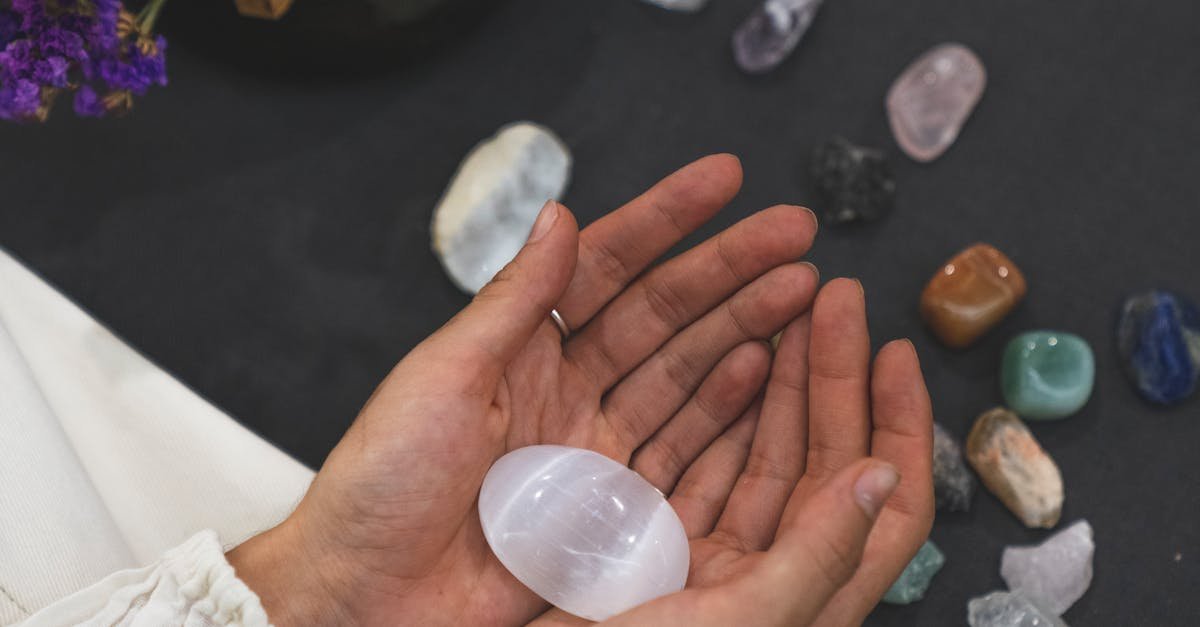
Mindful Holding: Select a crystal and hold it in your non-dominant hand. Close your eyes and take five slow breaths, focusing on the weight, temperature, and texture of the stone. This combines breathwork (proven to activate the parasympathetic nervous system) with sensory grounding and focused attention—all evidence-based calming techniques. Whether the crystal itself is “doing something” or the practice is creating the benefit becomes less important than the fact that you’re regulating.
Body Placement: Lie down and place a stone on your heart center or lower belly. The gentle weight provides what’s called “grounding pressure”—similar to why weighted blankets work. Breathe into the area where the stone rests. This is somatic therapy, using physical sensation to anchor awareness.
Carrying Stones: Keep a small stone in your pocket as a tactile reminder to pause and breathe throughout your day. The act of reaching for something physical interrupts anxiety spirals and brings you back to the present moment—a technique supported by cognitive behavioral therapy research.
Crystal-Infused Water (for external use): Place crystals around (not in) a glass of water overnight, then use the water to wash your face or hands as a morning ritual. The efficacy here likely comes from the ritual itself—beginning your day with intention and care—rather than the water being chemically changed. And that’s enough.
Creating Altar Space: Arrange crystals in a dedicated space for meditation or reflection. The act of creating sacred space, of having a physical location that signals to your brain “this is where I pause, where I breathe, where I connect”—this is deeply regulating, regardless of the objects used.
The Real Magic: Why This Matters Now
We’re living through a collective nervous system crisis. Chronic stress, digital overstimulation, environmental toxins, trauma, disconnection—our bodies are struggling to find equilibrium in conditions humans have never faced before. Pharmaceutical interventions help many people (and should never be stigmatized), but they’re not the only answer.
What if the future of healing isn’t about choosing between science and spirit, between medication and minerals, between therapy and tradition? What if it’s about integration?
Crystal work offers something our current medical paradigm often overlooks: it’s participatory, embodied, and relational. You’re not a passive recipient of treatment—you’re engaging with a practice. You’re touching something real, earth-made, ancient. You’re creating ritual in a rituall-starved culture. You’re slowing down in a world that demands constant acceleration.
The scientific mechanism doesn’t have to be fully proven for the practice to be valuable. We use many therapeutic modalities—talk therapy, meditation, breathwork, even hugging—where we can’t fully explain every mechanism but we can clearly see beneficial outcomes.
Here’s what makes crystal healing particularly relevant for our moment:
It’s non-invasive and accessible. You don’t need a prescription, a practitioner, or special training to begin exploring.
It reconnects us to the earth. These are pieces of the planet, formed over millions of years. In a world of synthetic everything, touching something genuinely ancient and natural has its own medicine.
It honors ancestral wisdom. Particularly for those of us with African heritage, working with stones can be a way of reclaiming practices that colonization attempted to erase or pathologize.
It complements other modalities beautifully. Crystals work alongside therapy, medication, bodywork, plant medicine, and community support—they’re not in competition with proven interventions.
It invites personal sovereignty. In a medical system where many feel disempowered, crystal work says: you have agency, you can explore, you can trust your own experience.
An Invitation to Return
I don’t know if the amethyst I held during that panic attack emitted a frequency that entrained my chaotic heart rhythms into coherence. I don’t know if its molecular lattice structure created a stabilizing field around my dysregulated nervous system.
What I know is this: it helped. The practice helped. The pause helped. The connection to something solid and earth-made helped. The permission to slow down and try something different from my usual anxious spiraling—that helped.
Maybe that’s enough. Maybe the most powerful healing happens not when we fully understand the mechanism, but when we’re humble enough to say, “I don’t know exactly how this works, but I’m paying attention to what helps.”
The invitation here isn’t to abandon critical thinking or to replace medical care with wishful thinking. The invitation is to expand your definition of what healing can include. To honor practices that your ancestors knew, even if modern science hasn’t caught up yet. To trust your direct experience alongside research studies. To remember that you’re not a machine to be fixed but a complex, vibrating, interconnected system seeking balance.
Crystals aren’t the future of healing because they’re magic bullets. They’re part of the future because they represent a return—to the earth, to our bodies, to ancestral knowing, to a more holistic understanding of what it means to be well.
So pick up a stone. Hold it. Breathe. Notice what shifts. Stay curious. Stay grounded. And remember: you’re not broken. You’re recalibrating. And sometimes, the steadiest thing in the room is a piece of the earth that’s been here long before our collective forgetting—patiently waiting for us to remember that we, too, are nature. We, too, can return to coherence. We, too, know how to heal.
A Note on Practice: Crystal healing is a complementary practice and should not replace medical care, therapy, or prescribed treatments. If you’re experiencing persistent anxiety, depression, or other mental health concerns, please reach out to a qualified healthcare provider. These practices work best as part of a holistic approach to well-being that includes professional support when needed.
Sources and Further Reading:
- McCraty, R., & Zayas, M. A. (2014). “Cardiac coherence, self-regulation, autonomic stability, and psychosocial well-being.” Frontiers in Psychology.
- HeartMath Institute research on heart rate variability and coherence (heartmath.org)
- Archaeological and anthropological texts on Kemetic stone use and African healing traditions
- Basic physics texts on resonance, oscillation, and crystalline structures
Leave a Reply