
What Obsidian Actually Is
Black obsidian is not a crystal. That distinction matters.
A crystal is a solid material whose atoms are arranged in a precise, repeating geometric pattern. Quartz is a crystal. Amethyst is a crystal. Obsidian is something different. It is a naturally formed glass, produced when silica-rich molten rock cools in a way that prevents atoms from organising into a crystal structure. The result is an amorphous solid, meaning its internal structure is disordered, more like frozen liquid than a mineral lattice.
Obsidian forms most commonly from rhyolitic and phonolitic volcanic eruptions. These lavas are rich in silica, which makes them extremely viscous. That viscosity, combined with the right cooling conditions, is what produces glass instead of crystals.
You will find obsidian at lava margins, in densely welded volcanic deposits, at the edges of shallow magmatic intrusions, and in volcanic blocks and fragments ejected by explosive eruptions. It appears on every inhabited continent where volcanic activity has occurred.
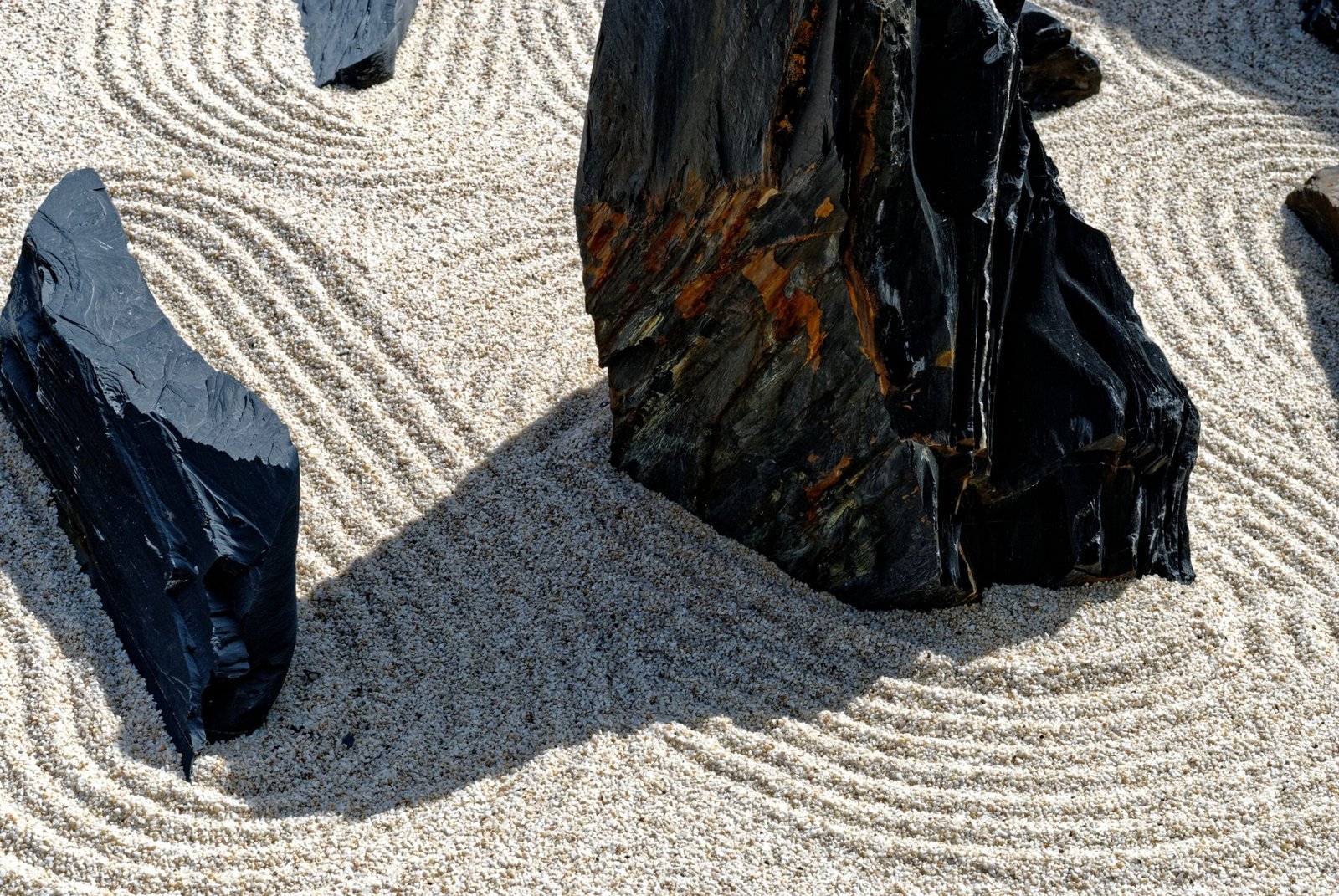
The classic description of obsidian is a glassy, dense, black or near-black material with a smooth, slightly reflective surface and a curved, razor-sharp fracture pattern. When it breaks, it does not split along flat planes the way many minerals do. It fractures in conchoidal curves, producing edges that are sharper than most metal blades.
The Chemistry of Black
The black colour of obsidian is not caused by a single ingredient. It results from a combination of iron chemistry, trace elements, and a phenomenon called intervalence charge transfer.
Obsidian is primarily composed of silicon dioxide (SiO2), typically making up around 70% or more of its composition. It also contains aluminium oxide, sodium oxide, potassium oxide, calcium oxide, and, critically, iron oxides.
Iron exists in glass in two forms: Fe2+ (ferrous iron, also written as iron II) and Fe3+ (ferric iron, also written as iron III). These two forms behave differently inside the glass network. Fe2+ tends to act as a network modifier, similar to calcium oxide, sitting between the silica chains rather than bonding into them. Fe3+ can behave more like a network former, playing a structural role closer to that of aluminium, potentially coordinating tetrahedrally within the glass.
When light interacts with both forms of iron simultaneously, an electron can transfer between adjacent Fe2+ and Fe3+ ions. This process is called an intervalence charge transfer, or IV-CT. It absorbs light across a broad range of visible wavelengths. The result is that very little visible light passes through the glass, and the material appears opaque and dark, often jet black.
Research on glass compositions similar to obsidian has shown that by changing the ratio of Fe2+ to Fe3+ in silicate melts, you systematically change not only the colour and optical properties of the glass, but also its thermal behaviour and structural connectivity. The iron redox ratio shapes how the glass network is built, which in turn affects properties like the glass transition temperature and thermal expansion. This means that the iron chemistry in obsidian is not just about colour. It is woven into the physical structure of the material.
The Formation Story Science Is Revising
For decades, the standard explanation for obsidian formation was straightforward: lava cools rapidly, atoms do not have time to form crystals, and glass is the result. This explanation is even embedded in popular culture. In the video game Minecraft, lava turns instantly into obsidian the moment it contacts water.
The rapid-cooling story is partially correct. The cooling does need to be fast enough to prevent crystals from nucleating and growing. But new research published in 2026 in Nature Communications, by Llewellin, Wadsworth, Sullivan and colleagues at Durham University, shows that this picture is fundamentally incomplete.
The puzzle the researchers set out to solve is this: when magma rises toward the surface, dissolved water comes out of solution and forms bubbles. These bubbles should be preserved as tiny holes, called vesicles, in the final rock. But dense obsidian worldwide contains less than 1% vesicles by volume. Where did all the bubbles go?
The team tested a specific hypothesis: that as lava cools, the solubility of water in the melt increases. In other words, the cooler the glass gets, the more water it can hold in dissolved form. This creates a chemical driving force for bubbles to shrink and disappear back into the surrounding melt. The process is called bubble resorption.
They confirmed this with a direct experiment at a synchrotron facility, using X-ray computed tomography to watch, in real time, what happens to bubbles inside a heated and then cooled obsidian-like glass sample. The bubbles grew during heating, then shrank and partially disappeared during cooling, exactly as the model predicted.
The modelling work showed something striking. For bubbles to fully resorb and produce the dense, vesicle-free obsidian we see in nature, the lava needs to cool slowly enough, on the order of 10 to the power of negative 4 to 10 to the power of negative 8 degrees Celsius per second. At those rates, cooling a lava flow to solid glass takes anywhere from a few days to several decades.
This does not contradict the crystal evidence. The same researchers showed that crystal nucleation in these melts requires at minimum around 45 years under optimal conditions. So the cooling window is real: slow enough for bubbles to resorb, fast enough for crystals never to form.
To put it simply, dense black obsidian is not born in an instant. It takes time. The lava cools over weeks or months. During that time, tiny gas bubbles dissolve back into the glass. The result is a dense, glassy material with almost no internal voids.
This is a two-step story. First, rising magma loses most of its gas through fractures or fragmentation. Then, during slow cooling, the remaining bubbles are absorbed back into the melt. What you hold in your hand when you pick up a piece of obsidian is the product of both processes, working across time.
Humans and Obsidian: A 12,000-Year Relationship
Long before anyone understood glass transition temperatures or intervalence charge transfers, humans recognised something fundamental about obsidian: it is one of the sharpest materials found in nature.
When obsidian fractures, it produces edges at the molecular scale. A skilled knapper, someone who works stone by striking it with controlled force, can shape obsidian into tools with cutting edges finer than most modern surgical steel. This property made obsidian extraordinarily valuable across thousands of years and across cultures that had no contact with one another.
Archaeological evidence places obsidian use in the Olduwian period, among the earliest known stone tool traditions. By the Mesolithic and Neolithic periods, obsidian was being traded and transported across hundreds of kilometres.
Research published on a prehistoric site in Kobuleti, western Georgia, dated to the 10th and 9th millennia BC, found obsidian tools sourced from three separate locations: the Chikiani mountain in southern Georgia, the Sarikamish region in eastern Turkey, and an “Akhshtu-type” source from the North Caucasus. The furthest of these sources was approximately 300 kilometres from the settlement in a straight line. These were not casual finds. People were deliberately seeking out and moving obsidian across significant distances, suggesting organised exchange networks, or what the researchers call “trade,” in raw materials.
Similar patterns appear across the globe. In the High Arctic, obsidian microblades dated to around 8,000 years ago have been traced to sources far from where they were found. In Mesoamerica, Aztec and Maya peoples used obsidian for blades, mirrors, and ritual objects. In parts of the Pacific, obsidian was traded between island communities separated by open ocean. In eastern Africa, early human sites contain obsidian tools traced to specific volcanic sources, some of them distant from the sites.
Obsidian was used for:
Cutting tools and knives, exploiting its fracture sharpness for hunting and butchery. Spear and arrowheads, shaped through careful pressure-flaking. Surgical tools, with healers in multiple cultures using obsidian blades for incisions. Ornaments and decorative objects, ground and polished to display its reflective, glassy surface. Mirrors, particularly in Mesoamerica, where polished obsidian mirrors held ritual and divinatory significance. Trade objects, moving along exchange networks as both raw material and finished goods. Ritual and burial items, placed with the dead or used in ceremonial contexts across cultures.
The Caucasus region, where Georgian and foreign researchers have traced obsidian procurement over the past several years, is described as one of the most active in terms of obsidian utilisation throughout prehistory. The material was sought out across this region from the earliest Holocene period onward, indicating that its value was recognised and pursued from the very start of settled human life in those landscapes.
Modern uses carry forward the same logic. Obsidian scalpels, used in certain ophthalmic and microsurgery procedures, produce cuts with less tissue trauma than steel blades because of their finer edge. In construction and materials science, similar volcanic glass compositions, including basalt-based products like Rockwool, are used as insulation. In prehistoric Scandinavia, vitreous rock melts were used as mortar in the rock wall emplacements of hillforts. The utility of this material, in various forms, spans millennia and continues today.
Why Black Obsidian Became Associated With Protection
The cultural and spiritual associations of black obsidian did not appear from nowhere. They developed, across different societies and time periods, in response to real properties of the material.
The sharpness is the most obvious starting point. A material that cuts cleanly has an intuitive association with boundaries, with the ability to separate one thing from another. Across cultures, sharp edges are symbolically linked to protection and to the removal of what does not belong. Obsidian’s extreme sharpness made it a practical tool for cutting, and over time, that function shaped its symbolic identity.
The black, reflective surface added another layer. Polished obsidian mirrors have been used in ritual contexts for thousands of years, particularly in Mesoamerica. The ancient Aztec deity Tezcatlipoca, associated with the night sky, rulership, and conflict, was linked directly to obsidian mirrors, sometimes called “smoking mirrors.” The idea that a dark, reflective surface could show hidden truths or reveal what lies beneath appearances is a symbolic logic that recurs across cultures.
The volcanic origin of obsidian carries weight of its own. Obsidian comes from deep within the earth, from molten rock, from geological forces that reshape landscapes. In many traditions, the earth itself is understood as a living, ancestral presence. A material born from volcanic fire and cooled into glass carries that origin with it.
The long history of human use reinforces the associations. When people across thousands of years reach for the same material for protection, ritual, and ceremonial purposes, that accumulated use becomes part of the object’s meaning. The symbolic weight builds.
Today, many people use black obsidian as a support tool in intention-setting and reflection practices. It is traditionally associated with protection, grounding, emotional clarity, and the drawing of boundaries. Many people describe using it in meditation, in spaces where they want to feel anchored, or as a physical reminder of internal commitments.
These meanings are cultural, spiritual, and symbolic. They are not proven medical effects. Black obsidian cannot diagnose or treat illness, alter genetics, or directly change biological processes. What it offers, in practice, is a tangible object with a remarkable scientific and historical story, one that many people find meaningful to hold, display, or work with as part of a broader reflective or spiritual practice.
The distinction between symbolic support and medical treatment matters. Holding an obsidian stone while setting an intention is not the same as taking medication. And yet, the value of ritual objects, symbols, and anchoring practices in human life is real, documented by anthropology, psychology, and cross-cultural study. The stone does not need to cure disease to be worth something.
A Note for African Readers: Skepticism Is Reasonable Here
If you grew up in South Africa, or elsewhere on the continent, and you find crystal use unfamiliar or unconvincing, that response makes sense.
Crystal healing as a commercial and spiritual practice is largely a product of Western, specifically Euro-American, new age culture from the late 20th century. It was not widely documented or mainstream in most African communities, and it arrived in many African markets as an imported product with imported symbolism. Being skeptical of something with those origins is reasonable.
But the story of obsidian itself is not a new age invention. It is geology, chemistry, and archaeology. Obsidian is a real volcanic glass with measurable chemical properties. Its formation is studied by university researchers and published in peer-reviewed journals. Its use by ancient humans is documented by archaeologists on every inhabited continent, including in Africa, where early human sites have yielded obsidian tools traced to specific volcanic sources across the continent.
The spiritual and cultural meanings attached to obsidian are human constructions, built over thousands of years across multiple cultures. Africa has its own traditions of earth materials, minerals, and stones carrying meaning, from the use of ochre in burial rites reaching back over 100,000 years, to the sacred significance of specific stones and landscapes in various southern African traditions. The idea that a material from the earth carries meaning is not foreign to African thought. What is foreign is the specific Western packaging.
If you choose to work with obsidian as a symbolic or reflective object, you are participating in something with deep roots in human experience, including human experience on this continent. If you choose not to, you are also making a reasonable choice. The science stands either way.
What This Stone Carries
Black obsidian holds a rare combination of properties. Geologically, it is a naturally formed glass with a chemical complexity that researchers are still working to fully understand. The role of iron in shaping its colour, structure, and thermal properties is an active area of materials science. The story of how it forms, through a specific and previously underestimated cooling process, was only clarified in 2026 research.
Archaeologically, obsidian is among the most globally traded materials in human prehistory. People walked hundreds of kilometres to obtain it, built exchange networks around it, and left it in graves and sacred sites. Its utility as a cutting material drove human innovation for tens of thousands of years, and that utility continues in modern surgical applications.
Culturally, obsidian has accumulated meaning across dozens of unrelated traditions, most of them pointing toward similar themes: sharpness, boundaries, protection, reflection, and connection to the earth’s deep forces.
You do not have to believe in any particular spiritual framework to find obsidian worth your attention. The science alone is genuinely interesting. The human history alone is substantial. The symbolic traditions, wherever you stand on them, are real expressions of how humans across time have understood a remarkable material.
That is what this stone carries.
References: Llewellin et al., “Obsidian forms by slow cooling,” Nature Communications, 2026. Chkhatarashvili, G., “New Data of Obsidian Procurement and Mobility of Ancient Humans,” 2025. Tuffen et al., “Obsidian,” Encyclopedia of Geology, Second Edition, 2020.
Leave a Reply