Crystals for Stress Periods
Life in South Africa is demanding. Work pressure, financial strain, load-shedding, unemployment, safety concerns, and family responsibilities all build on each other. According to SADAG (South African Depression and Anxiety Group), over 16 million South Africans live with some form of mental health condition, with stress among the most commonly reported challenges. The World Health Organization estimates that depression and anxiety cost the global economy $1 trillion in lost productivity each year. Many people are carrying more than they show.
When formal support is not accessible or not enough on its own, people look for grounding. Some pray. Some journal. Some exercise. Many reach for objects with personal meaning. Crystals are one of those tools.
Stress Is Real, And People Look For Grounding Tools
Stress is a physiological and psychological response to perceived pressure. It is a normal human function. Short-term stress helps you respond quickly to threats. Chronic stress, the kind that builds over weeks and months, is what causes lasting damage.
Research from the American Psychological Association shows ongoing stress disrupts sleep, reduces concentration, impairs decision-making, and increases emotional reactivity. You become more irritable. Your memory suffers. Fatigue becomes a constant state.
In South Africa, stressors are layered. Stats SA data places unemployment above 32 percent. Financial stress, safety concerns, family obligations, and economic pressure are widespread. SADAG reports 75 percent of people with mental health conditions in South Africa do not receive treatment. Many South Africans carry this weight daily without adequate support. People are overwhelmed. They are finding their own ways to cope.
Why People Use Crystals During Stressful Times
Crystals have been used across cultures for thousands of years. Ancient Egyptians, Chinese healers, Indigenous communities, and African traditional practices used stones as spiritual tools, symbolic objects, and ritual anchors.
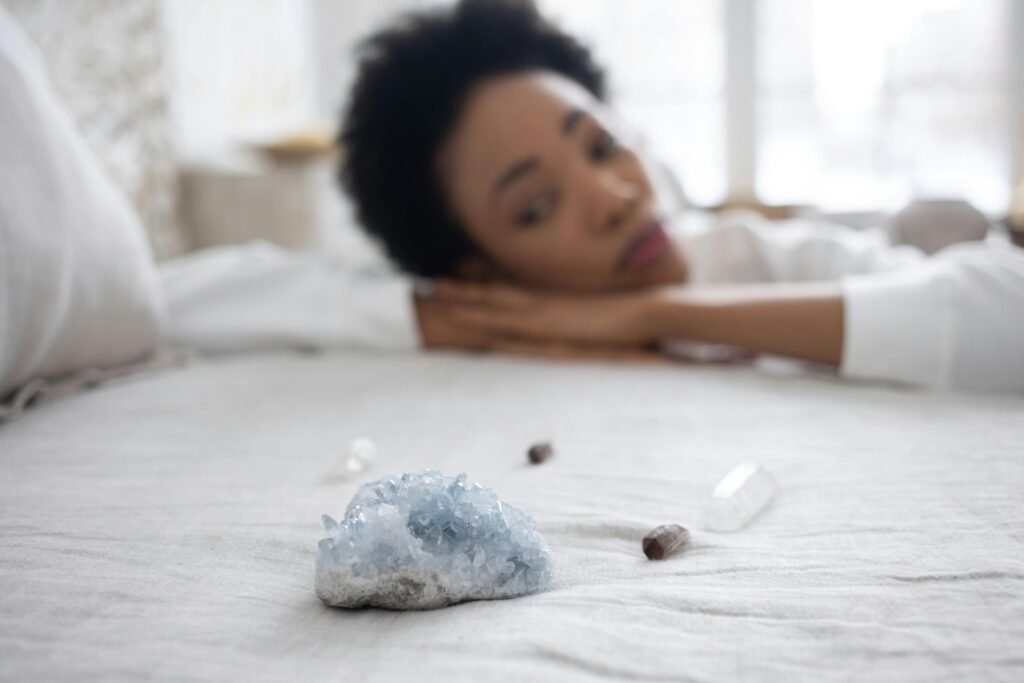
Today people use crystals during stressful periods because they offer something physical. You hold one. You wear it. You keep it on your desk or bedside table. It gives you a tangible focus point during emotionally heavy moments.
To be direct: there is no strong clinical evidence that crystals directly reduce stress or treat any health condition. The benefit people report is connected to ritual, meaning, touch, and intention. When something reminds you to pause, breathe, and reflect, it has value. The object is the cue.
This works the same way a photograph reminds you of someone you love, or a specific song brings you back to a calmer time. The stone does not fix anything. The practice you attach to it creates the shift.
The Science Around Grounding, Ritual, And Physical Reminders
Psychology supports the idea that physical objects play a role in emotional regulation. Research in behavioral psychology shows environmental cues, including objects, trigger habitual responses. If you consistently hold a stone while breathing slowly and pausing, that object becomes associated with that calmer state over time.
A 2017 study published in Psychological Science found rituals, even simple ones, reduce anxiety before stressful tasks. The structure of a ritual creates predictability. Predictability reduces the felt sense of threat.
Mindfulness practices have a stronger evidence base. A systematic review published in JAMA Internal Medicine found mindfulness meditation programs showed moderate improvements in anxiety, depression, and pain management. Crystals fit into this space as tactile anchors. You hold one to remind yourself to breathe, focus, and return to the present moment.
They work best as part of a real routine, not as a standalone fix.
7 Crystals People Commonly Use : Crystals for Stress
Amethyst
Amethyst is a purple variety of quartz. Its color comes from iron impurities and natural irradiation during formation. People use it as a tool for calm reflection and emotional stillness, particularly in the evening. Keep it near your bed, hold it during breathing exercises, or place it where you do your evening reflection. Bracelets and tumbled stones both work well.
Black Obsidian
Obsidian is volcanic glass. It forms when lava cools rapidly, preventing crystal structures from forming. It is dense, smooth, and grounding to hold. People use Black Obsidian for emotional boundary work and grounding during heavy periods. Wear it as a bracelet or keep a tumbled stone nearby during difficult conversations.
Hematite
Hematite is an iron oxide mineral and a major iron ore. It is heavy for its size and has a metallic luster when polished. Many people reach for it when they need to feel mentally and physically steady. Hold it during moments of overwhelm. Its weight makes it a popular bracelet stone.
Tiger’s Eye
Tiger’s Eye is a quartz-based stone with chatoyancy, a silky reflective banding caused by parallel fibers within the stone. It occurs naturally in South Africa, particularly in the Northern Cape. People use it when they need confidence and mental clarity. Wear it during work presentations, interviews, or when making difficult decisions.
Rose Quartz
Rose Quartz is a pink variety of quartz. Its color comes from trace amounts of titanium, iron, or manganese. People use it during periods of emotional sensitivity, grief, or when they need to practice self-compassion. It pairs well with journaling and evening reflection routines. A tumbled stone or bracelet is practical for daily use.
Blue Lace Agate
Blue Lace Agate is a banded form of chalcedony with soft blue and white layers. People associate it with calm expression and clear communication. Keep it nearby when you need to work through a difficult conversation or process emotions without reacting impulsively.
Sodalite
Sodalite is a blue tectosilicate mineral often used as an ornamental stone, distinguished by deep blue coloring and white calcite veining. People use it for mental clarity and rational thinking during demanding periods. Keep a piece on your desk during planning, studying, or when you need focused, clear thinking.
Best Crystal Combinations For Stressful Periods
Black Obsidian, Hematite, and Tiger’s Eye work well together. This combination addresses grounding, stability, and mental strength. VIKA from Ozyn Wellness combines all three stones in a single daily bracelet. It is a practical wearable for people who want a physical reminder to stay grounded during emotionally heavy or stressful periods.
Amethyst and Rose Quartz pair well for emotional recovery. Use them during quiet evenings, journaling, or when you feel emotionally drained rather than mentally overloaded.
Blue Lace Agate and Sodalite work for communication and clear thinking. Keep them on your desk or wear them on days when your mind feels cluttered and decision-making feels hard.
How To Use Crystals In A Stress Routine
Hold the stone and take five slow breaths. Inhale for four counts, hold for four, exhale for six. Name what you are feeling. Research from UCLA on affect labeling shows naming your emotion out loud reduces its intensity by reducing amygdala activation. One word is enough. Anxious. Tired. Overwhelmed.
Set one simple intention. Not a list. One word or phrase. Focus. Calm. Steady.
Wear your bracelet as a daily reminder to pause. Every time you notice it on your wrist, treat it as a prompt to check in with yourself.
Keep a stone on your desk while working. When focus slips, pick it up for thirty seconds.
Use crystals during prayer, meditation, or journaling. Let them mark the start of your practice. Place a stone near your bed as part of your evening wind-down.
What Crystals Can And Cannot Do
Crystals are supportive ritual tools. They are not medical treatments.
They are useful for supporting emotional rituals, acting as mindfulness anchors, helping you remember your intention, adding meaning to prayer and meditation, and giving you something physical to hold during stressful moments.
They do not replace therapy, medical care, or professional mental health support. They do not fix chronic stress on their own. They do not replace sleep, physical exercise, financial planning, healthy boundaries, or professional help. They do not treat anxiety, depression, trauma, or burnout.
If you are experiencing persistent mental health challenges, speak to a professional. In South Africa, SADAG is available on 0800 567 567.
Choosing The Right Crystal For Your Stress
If you feel emotionally heavy, start with Black Obsidian or Hematite. If your mind is overwhelmed, reach for Sodalite or Amethyst. If you feel emotionally tender and need self-compassion, choose Rose Quartz. If you need to show up with confidence, choose Tiger’s Eye. If you struggle to say what you feel, keep Blue Lace Agate close. If you want one grounding tool for daily wear, VIKA carries the three grounding stones in a single bracelet.
Final Thoughts
Crystals are most useful when they are part of a real support routine. The value is not in the stone itself. The value is in what the stone reminds you to do. Pause. Breathe. Reflect. Pray. Journal. Return to yourself.
Use them consistently. Attach meaning to them. Let them be the cue to bring you back to your practice.
Explore Ozyn Wellness crystal bracelets and emotional support companions for grounding, clarity, protection, and calm energy at shop.ozyn.co.za.
FAQ
What are the best crystals for stress? Commonly used crystals during stressful periods include Amethyst, Black Obsidian, Hematite, Tiger’s Eye, Rose Quartz, Blue Lace Agate, and Sodalite. Each suits a different aspect of stress. Amethyst suits evening calm. Tiger’s Eye suits mental pressure. Hematite suits grounding when you feel unsteady.
Do crystals really help with stress? Crystals do not directly reduce stress. What many people find helpful is the ritual attached to using them. Holding an object, breathing, setting an intention, and pausing are all practices with support from psychology research. The crystal serves as the cue for those practices.
Is there scientific proof crystals reduce stress? There is no strong clinical evidence crystals directly reduce stress. Research does support rituals, tactile grounding, and mindfulness practices as tools for emotional regulation. Crystals work best as part of those practices.
Which crystal is best for emotional grounding? Black Obsidian and Hematite are the most commonly used for grounding. VIKA from Ozyn Wellness combines both with Tiger’s Eye as a daily grounding bracelet.
Is it okay to wear crystals every day? Yes. Many people wear crystal bracelets as daily reminders. Consistency builds the habit. The more you attach a pause or breathing practice to wearing the bracelet, the more useful it becomes over time.
What crystal bracelet is good for stressful periods? VIKA by Ozyn Wellness combines Black Obsidian, Tiger’s Eye, and Hematite. It is designed for daily wear during emotionally demanding or stressful periods as a grounding and stabilising reminder.
Sources: South African Depression and Anxiety Group. sadag.org World Health Organization. Mental health in the workplace. who.int Statistics South Africa. Quarterly Labour Force Survey. statssa.gov.za Hobson NM, Inzlicht M, Risen JL. (2017). The Psychology of Rituals. Psychological Science. Goyal M et al. (2014). Meditation Programs for Psychological Stress and Well-being. JAMA Internal Medicine. Lieberman MD et al. (2007). Putting Feelings Into Words: Affect Labeling Disrupts Amygdala Activity. Psychological Science. American Psychological Association. Stress effects on the body. apa.org